

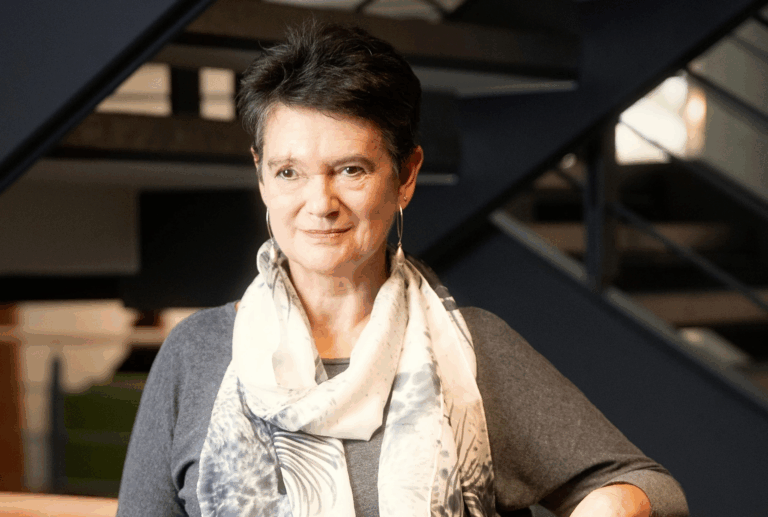
It is essential that policy is shaped by evidence-based decision-making, but in the current climate the need to make that case, underpinned by rigorous, interdisciplinary policy research, has never been more urgent. At the forefront of this mission stands Churchill Fellow, Professor Dame Diane Coyle, Research Director of the newly established Bennett School of Public Policy at the University of Cambridge, which recently expanded from the Bennett Institute for Public Policy.
From Institute to School: A Strategic Evolution
The Bennett Institute for Public Policy launched in April 2018 with support from Churchill alumnus and philanthropist Peter Bennett. The transition from Institute to School marks a significant milestone in Cambridge’s commitment to public policy education and research, establishing a new department that reflects both the success of the original venture and Cambridge’s recognition of the growing need for interdisciplinary policy expertise.
The Bennett Institute now forms the research core of the expanded School of Public Policy, which has significantly enhanced its educational offerings and capacity. Professor Michael Kenny serves as Head of Department, while Dame Diane leads as Research Director.
Defending Evidence in Policymaking
The need for policymaking to be supported by evidence is particularly critical in the current political climate. Together with Professor Kenny, Dame Diane recently published a piece in Nature addressing the actions needed to restore science to policymaking at a time when it faces serious attacks, including building public trust in a political climate of “post-truth politics” and “alternative facts”, exemplified by the Trump administration.
The argument is clear: the erosion of trust in science stems partly from scientists themselves, who must recognize that the importance of evidence is not self-evident.
Rebuilding support for evidence-based policymaking requires academics to change their outlook, engage more deeply with policymakers and citizens, and acknowledge that public policy solutions are rarely purely technical they inevitably involve competing values and interests that scientific studies alone cannot resolve.
An Interdisciplinary Approach to Complex Challenges
Today’s challenges, from effective uses of AI to reviving towns and regions, demand solutions that reflect expertise across disciplines and sectors. The School tackles major policy challenges that inherently require interdisciplinary approaches:
Artificial Intelligence and the digital economy: Understanding AI’s economic impact on industrial policies requires collaboration between computer scientists, economists, engineers, and policymakers. The School investigates how businesses adopt AI technologies and works with the Civil Service on AI workflows.
Regional inequality and spatial disparities: Addressing the persistent gap between prosperous cities and “left behind” post-industrial regions demands insights from economics, geography, political science, and sociology. The School’s research on place and productivity has already influenced governments, NGOs, and central banks worldwide.
Environmental sustainability: Tackling climate change and biodiversity loss requires understanding natural capital, ecosystem services, and the intersection of human and natural systems. Bennett Institute researchers have collaborated with the United Nations on natural capital accounting.
Democratic governance: Examining the future of the British Constitution, devolution, and how to bring together UK mayors and devolved leaders most effectively.
The School attracts researchers who thrive working across disciplinary boundaries, supported by seminars, social encounters, and an enthusiastic collegiate atmosphere. As Dame Diane describes it, the School operates like a kaleidoscope, with different elements coming together in ever-changing, creative configurations.
Funding and Partnerships
The School’s research funding portfolio reflects the breadth of its work and its commitment to engaging all sectors. Support comes from diverse sources including the Economic and Social Research Council (ESRC), the Productivity Institute, the MacArthur Foundation, the Rockefeller Foundation, and the Office for National Statistics. The School has also developed a distinctive partnership with KPMG focused on wellbeing and productivity—demonstrating how private sector engagement can enrich public policy research.
Expanding Educational Offerings
The School has significantly expanded Cambridge’s public policy education offerings and is currently recruiting Associate and Assistant Professors, as well as a Chair to build its interdisciplinary faculty.
The groundbreaking MPhil in Digital Policy, designed by Dame Diane, began accepting applications for October 2026 entry. “The MPhil in Digital Policy is an interdisciplinary course spanning economics, political science, computer science and law,” says Dame Diane, who is the Course Director. “It is designed to address pressing 21st-century challenges ranging from online safety and regulation to harnessing emerging technology trends for productivity and growth.”
In September 2026, applications will open for a new PhD program commencing in October 2027. This serves dual purposes. First, it strengthens the School’s cross-disciplinary research capacity by bringing in scholars from various home disciplines to conduct cutting-edge policy research while engaging directly with actual policymakers, business leaders, and third sector organizations. Second, it responds to evolving student demand. As Dame Diane explains, increasing numbers of Master’s students recognise that deeper methodological knowledge is valuable regardless of whether graduates pursue academic, government, or private sector careers.
The well-established MPhil in Public Policy, previously delivered through the Department of Politics and International Studies, is now offered through the Bennett School and includes two Kanders Churchill Scholars.
The Churchill College Connection
The School’s relationship with Churchill College runs deep and proves mutually beneficial. The Bennett Institute holds its annual conference at Churchill each March, with hundreds of practitioners, academics, and policy experts addressing pressing public policy challenges, from AI disruption to infrastructure resilience to democratic governance. The Master of Churchill College hosts welcome receptions for the School’s new student intakes, fostering connection to the broader College community.
This connection embodies what Dame Diane identifies as distinctive about Churchill College: scientific excellence combined with interdisciplinary cross-fertilization and a passion to drive meaningful change. The Kanders Churchill Scholarship was specifically created to bridge the gap between science and science policy, funding STEM graduates to pursue policy MPhils.
A Vision for Impact
The School plays a vital role in ensuring research and evidence effectively reach decision-makers and influence outcomes. In today’s turbulent political and technological landscape, this work has never been more important or meaningful.
Dame Diane’s own work exemplifies this commitment to making research accessible and impactful. Her most recent book, The Measure of Progress: Counting What Really Matters (April 2025), argues that the economic statistics developed in the 1940s function as outdated tools that hinder policymakers’ ability to address modern challenges. The book will be featured in the next Churchill College Master’s Book Club, continuing the vital conversation about how we measure and achieve genuine progress.