
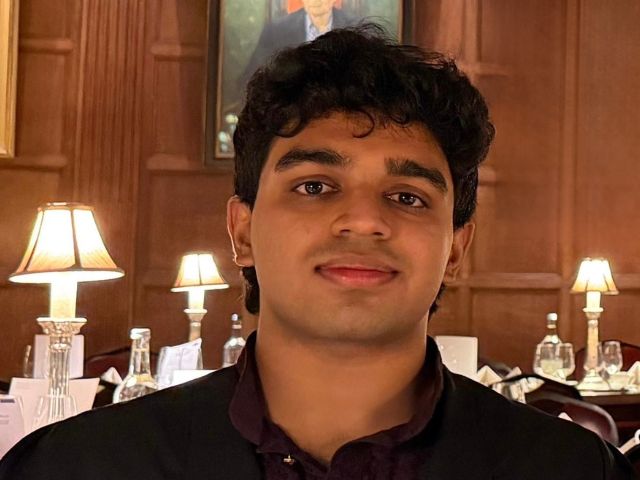
Churchill medical student Aryan Sagdeo spent last summer developing diagnostic tools that could transform how doctors identify T cell lymphomas, thanks to funding from the College’s Summer Opportunities Bursary scheme.
Aryan worked in the Soilleux Group at Addenbrooke’s Hospital where researchers are developing machine learning software for disease diagnosis and investigating new approaches to detecting immune cell cancers. The group, which is led by Churchill Fellow Prof. Liz Soilleux, recently demonstrated near pathologist-level accuracy in diagnosing coeliac disease through their startup, Lyzeum Ltd. Aryan’s primary project focused on validating a novel diagnostic test for T cell lymphoma, a challenging cancer to identify. Currently, doctors rely on costly and labour-intensive techniques. The Soilleux Group has developed and patented antibodies that could provide a simpler, more accessible diagnostic alternative, similar to existing tests for other types of lymphoma.
As Aryan explains, the project ran into a puzzling problem. The diagnostic test is based on a key fact about immune cells: each T cell should only have one version of a particular receptor protein. However, other researchers using less specific antibodies claimed to have shown that some benign T cells seemed to have both versions at once, something that shouldn’t happen.”We had to prove these results were probably errors, using genetic data to show that each cell actually had just one functional version of the receptor gene, not two.”
Aryan had to quickly learn new computer skills to analyse genetic data from online databases. When the computer analysis wasn’t enough, the team grew and tested some T cells directly in the lab. Aryan’s findings, documented in a detailed report, will help the lab continue developing this diagnostic test.
Aryan also contributed to two additional research streams during his placement. One involved demonstrating that older clinical slides could be re-stained for markers to help work out which cells were of particular types, years after initial slide preparation, a result with the potential to unlock archived slide material for new research. The other involved annotating work supporting the group’s machine learning image analysis work. Overall, he learned to operate automated staining equipment, perform high-quality slide preparation, and interpret complex genetic sequencing data, all practical laboratory skills that complemented his theoretical medical training.
Above all, Aryan learned about the incremental process of research. “I found myself deeply absorbed in the challenges each day brought. Working in a non-teaching research lab exposed me to the reality of scientific progress: days spent troubleshooting experiments, interpreting ambiguous results, and engaging with researchers whose curiosity drives advances in patient care.”
While he hasn’t yet chosen a medical specialty, the experience strengthened Aryan’s ambition to integrate research into his clinical career by demonstrating that academia was not an abstract ideal, but a practical, collaborative, and rewarding way of contributing to medicine.
None of this would have been possible without College support. As Aryan explains, “Research placements allow students to engage with the realities of academic medicine and cultivate skills that cannot be gained through the standard curriculum alone. The financial barrier is two-sided: students should expect fair compensation, yet labs may lack funds to support interns despite their eagerness to teach. This often results in students having no positions at all.”
By removing financial barriers, Churchill’s Summer Opportunities Bursary scheme ensures that access to formative academic experiences is determined by interest and merit rather than economic circumstance.
The Summer Opportunities Bursary scheme is made possible by the generosity of Churchill alumni, whose donations make such funds available to students