

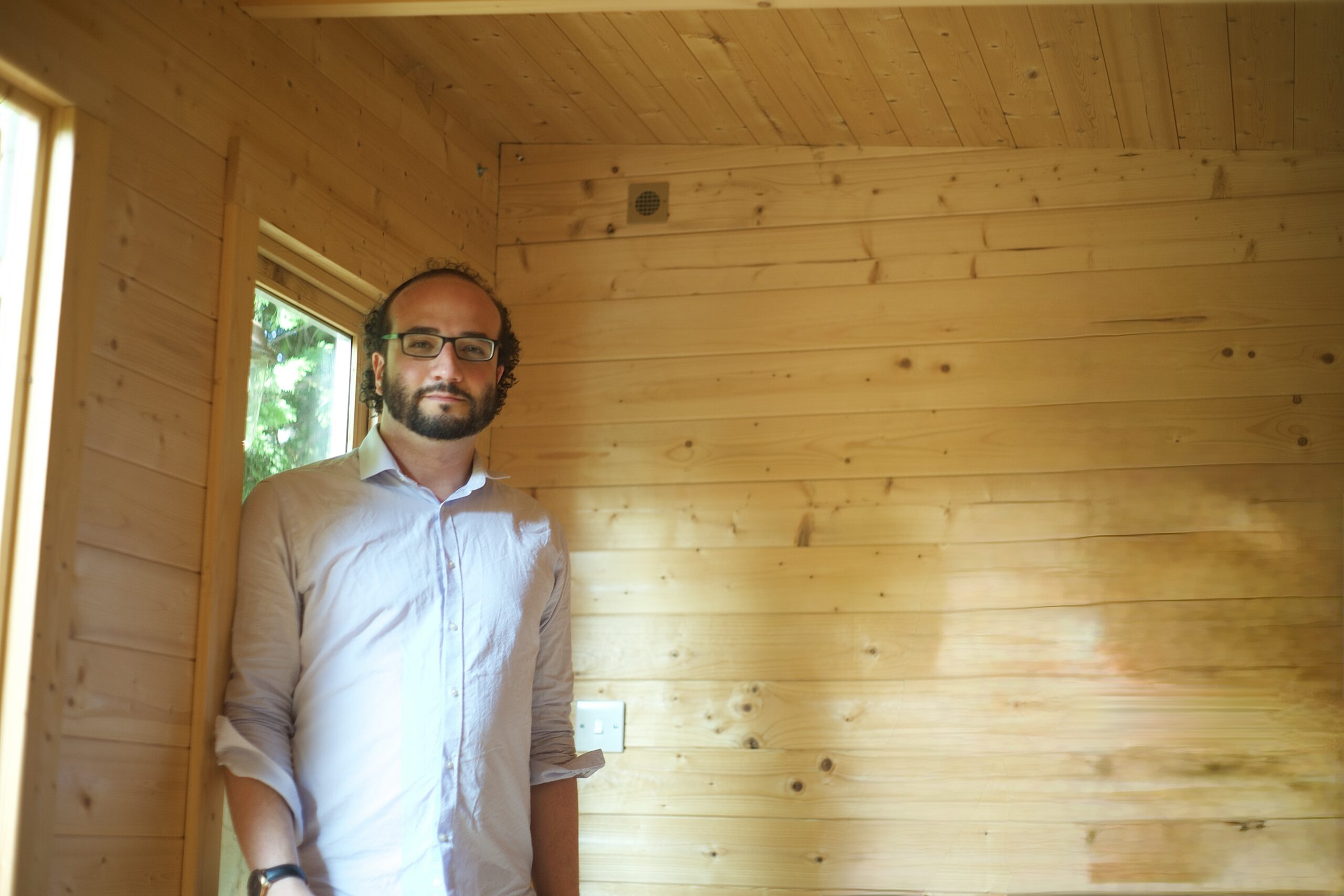
Søren Hough completed his PhD at Churchill College in 2023. That work has culminated in an EMBO Molecular Medicine paper that describes a new diagnosis, DIADEM.
DIADEM (Developmental delay and Intellectual disability Associated with Defects in MAEA) is caused where a particular missing protein impairs DNA repair and replication causing developmental delay. Find out how this discovery came about, and where to next for this research…
So where did the project come from?
“When I started in Steve Jackson’s lab, I was assigned to work on a particular project that was looking at these kinds of proteins called E3 ubiquitin ligases, which I knew very little about at the time.
It turns out E3 ubiquitin ligases are the proteins that modify other proteins. They give them the extra “bells and whistles” that make them do things that they wouldn’t necessarily normally do. Or, they mark proteins so that they’ll be destroyed, so that the cell can turn them over and create new proteins.
We know E3 ubiquitin ligases like BRCA1 are involved in DNA repair, people with BRCA1 mutations are at a higher risk for breast cancer. I conducted a genetic screen to find other E3 ubiquitin ligases that are potentially involved in these processes that we haven’t found yet.
The screen pointed to a whole complex called CTLH that hadn’t really been associated with these processes, which was exciting. I started looking at what a core CTLH protein, MAEA, is actually doing, and how it interacts with other proteins to try and understand its role in repair and replication. We found that turning MAEA off has pretty serious consequences for particular DNA repair pathways.
Meanwhile, I was always interested in clinical applications biological research. If you can draw a connection between basic science and the clinic, there’s just something tangible about that that I find very motivating. So as I was doing this work in the lab on the cellular and molecular level, I also started putting out feelers. There’s a bunch of databases where you can submit a gene of interest and ask if any clinicians out there, any doctors or genetic counsellors, have found patients with variants in a particular gene. That can lead to collaborations.
Slowly we’d get these emails from clinicians all over the world that identified patients with variants in MAEA. As we gathered them together, we were able to see similarities and differences across these eight patients.
Gathering that cohort allowed us to also start modelling some of these patient variants. We quickly saw some pretty serious DNA repair impairment, similar to what happens when you turn MAEA off. Our colleagues at the University of Birmingham similarly found that patient variants led to replication issues in our cell lines. That was really exciting because it started to connect some of these dots.
Towards the end of the project, we also were very fortunate to get some tissue samples from the patients. This wasn’t just us modelling their mutations in a laboratory cell line, these were actual cells from the patients. Those ended up going to the University of Birmingham, where our colleagues again observed the impaired replication phenotypes we had seen previously. That helped us further cement the link between DIADEM and DNA repair and replication.”
What is the impact of discovering that MAEA links to this development disorder?
“There are a couple of positive outcomes of characterizing DIADEM. If you’re a parent hearing that your child is developmentally delayed, but the doctors are not really sure why and it’s linked to some gene you’ve never heard of — I think that giving it a name and finding out there’s other people who are also going through this is really helpful in that sense.
Also, if you as a parent or as a clinician wants to look at the latest research on DIADEM, assuming more papers are published on this, which I imagine there will be as time goes on, there’s more information for families to dig in to if they want. I think information is power. Just having that knowledge is really comforting, I think, as is knowing that you’re not the only one. There are other families who are also going through this.
There are other aspects to it as well. As I mentioned, missing BRCA1/2 genes are related to faulty DNA repair and breast cancer. Similarly, if losing MAEA or having a variant in MAEA can lead to inefficient DNA repair and replication, you may be susceptible potentially to cancer. We don’t know that yet.
But what is definitely the case is that cells we’ve looked at with variants in MAEA, or that are missing MAEA altogether, are vulnerable to certain chemotherapeutics or to certain cancer drugs that are in use right now in the clinic. And so if DIADEM patients were to develop cancer, their clinicians may want to be a little bit careful about giving them particular drugs because they may be more sensitive to them than other people, which is really important, you want to go in with all of the facts. The clinicians might not be on the lookout for that otherwise.”
Where next for this work?
“It’s important to know that MAEA is part of the 10-protein CTLH complex. CTLH is big and likes to form smaller subcomplexes made up of various combinations of its subunits. Determining which of these subcomplexes MAEA is important for could help us further understand its role in DNA repair and disease.
In terms of follow-on research, we have already collected a cohort of patients just like we did before, but for a completely different member of the complex. Again, we’re seeing a lot of the same sort of global developmental delay issues for patients with variants in this particular gene.
We’ve already shown in the MAEA paper that other subunits appear to have a role in DNA repair and replication. So I would say that it’s unlikely MAEA is acting alone. It almost certainly is working in concert with other components of this complex. I think we’re going to find that other CTLH variants lead to issues, and that maybe they contribute to an interrelated of set of conditions like DIADEM.
In other words, the picture is much more complicated than what we laid out, as you might expect from just one paper. And I think there are going to be a lot more connections between these different components as more research is done in this area. But there’s only so much you can fit into one study.”
What advice do you have for students thinking about working or studying in this area?
“I would say, first of all, have a light at the end of the tunnel of what you want to do. I’m a science journalist now, and that’s what I said I wanted to do in my PhD application. That has been my North Star.
You also have to care about the project. There was a point during my PhD where I was like, I don’t want to hear about MAEA anymore. This is too much. A PhD is about focussing on the same thing for a long time, so you really have to be invested. A huge boost to that was finding a clinical connection because suddenly it wasn’t just an abstract protein; there were people who actually have variants in this complex.
I would say to postgraduate students, take vacations, take time off, don’t work yourself till 2am or come in every single evening and weekend. There’s a real diminishing returns situation where you just burn yourself out. Find a way to have that rest and recovery, if you have facilities in a College or whatever. Just taking time out is so important for your own mental health. I think people don’t look after themselves in graduate school and I think that that’s something that we should pay more attention to.”
What was it like being at Churchill for your PhD?
“I had a strong relationship with the College and there was a lot of support for things beyond the accommodation. I got grants to help with a personal project on the work of evolutionary biologist Marie Goldsmith, funded by the Jennie Churchill and Tizard Opportunities Fund. I also got opportunities to speak about my MAEA/DIADEM project at the Conference On Everything and about bioethics in a CHUtalk. I found all of that to be super useful experience.
Unfortunately, I moved into Churchill accommodation (Wolfson Flats) just as we went into lockdown, so I didn’t really get to make the most of the college’s amenities. Still, I found the beautiful grounds and accommodation were a real boon amid the restrictions. My partner Anya and I had a great experience.”
You can read Søren’s paper in full at https://link.springer.com/article/10.1038/s44321-025-00352-x