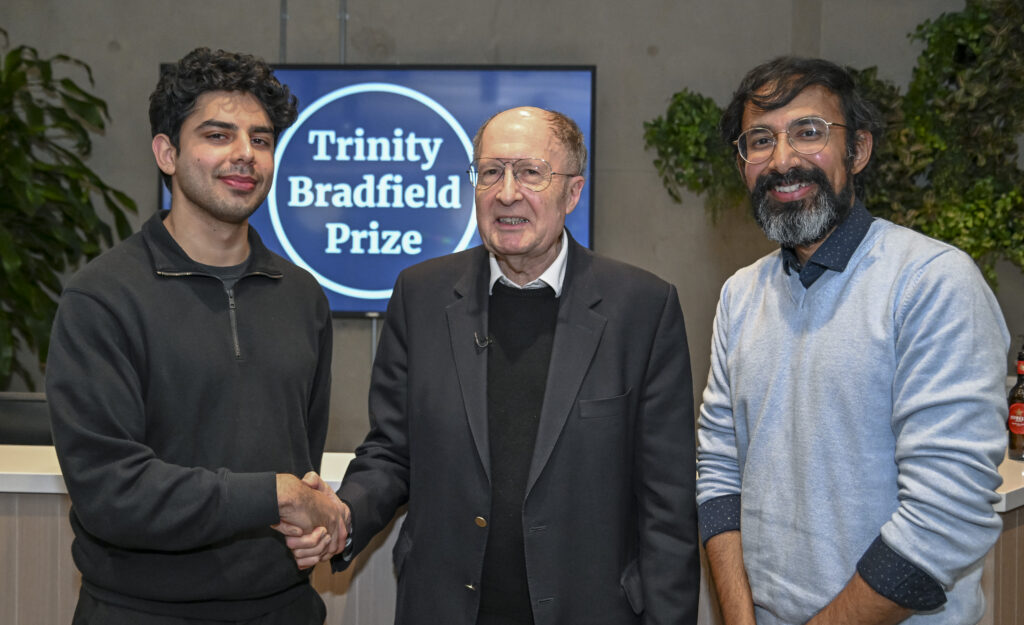

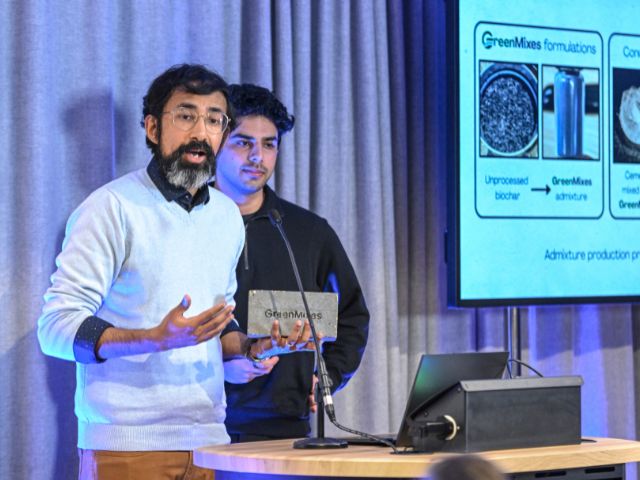
Dr Dushanth Seevaratnam completed his PhD in Engineering at Churchill College in 2022. Now a Postdoctoral By-Fellow at the College and a research associate in the Fluids in Advanced Manufacturing group at the Institute for Manufacturing, he co-founded GreenMixes alongside Callon Peate, a PhD student at Clare College, winning the £10,000 first prize at the Trinity Bradfield Prize 2025/26 for their efforts. Now in its seventh edition, the Prize has received over 500 applications and awarded more than £155,000 in cash prizes – and this year’s winning entry may be among its most timely yet.
GreenMixes has developed a proprietary biochar-based admixture (a material added to concrete during mixing) that can replace up to 15% of the cement in a standard concrete mix. Biochar, a stable form of carbon produced by heating agricultural and organic waste in low-oxygen conditions, is a well-established carbon store. GreenMixes’ innovation lies in chemically modifying the biochar so that it integrates into concrete without the strength loss that typically accompanies carbon-loaded mixes. The result is a drop-in solution: no new equipment, no changes to existing workflows, and a concrete that actively sequesters carbon rather than emitting it.
We sat down with Dr Seevaratnam to find out more.
You described the Trinity Bradfield Prize as “rare to have a competition that is so inclusive and nurturing” – what did you mean by that?
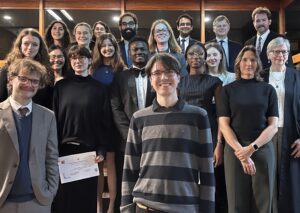
The competition gave all finalists the chance to practise their pitches together across two sessions with the organisers. Both the organisers and the other finalists offered constructive feedback, which is uncommon enough in itself, but it’s even rarer for those sessions to involve the very teams you’re competing against.
Going through that process together created a genuinely collaborative atmosphere. It felt less like a competition and more like we were all representing Cambridge and its innovation ecosystem in our own unique ways.
Where did the idea for GreenMixes come from?
The inspiration came from separate trips to India – my co-founder Callon visited his extended family, and I visited my wife’s family. The sheer quantity of concrete we each encountered, from residential apartment blocks to large-scale infrastructure, was astonishing.
Later, during a tea break at the Institute for Manufacturing, Callon explained the direct climate impact of cement production. That conversation ultimately sparked the idea and set everything in motion.
How quickly did things move from that initial idea to a registered company?
Everything began in August 2025, and we registered the company with some preliminary data around the end of October 2025, so roughly one to two months from idea to incorporated company.
The judges highlighted “the scale of impact” your solution could deliver – can you put some numbers on that?
Cement is the second most-used material on Earth and accounts for around 8% of global CO₂ emissions – more than shipping and aviation combined. In the UK alone, 90 million tonnes of concrete are consumed every year.
The admixture GreenMixes is developing can replace up to 15% of the cement used in concrete, while locking away enough carbon to offset the emissions from the remaining cement. We are capable of sequestering 2.55 tonnes of CO₂ per tonne of admixture, meaning even at that replacement level, the overall climate impact can be substantial.
How does GreenMixes concrete actually differ from standard concrete?
Generally, biochar-based concrete tends to be weaker, but that’s precisely what makes GreenMixes different. We modify the carbon so that no strength loss occurs. The result is a concrete with the same structural properties, with one visible difference: it comes out black or dark grey due to the carbon loading.
The biochar in your admixture is produced from agricultural waste – what kind of materials are involved?
Some of the best waste feedstocks for biochar production include nut shells, fruit pits, wood chips, coconut shells, rice husks, and corn cobs. At the moment we purchase biochar from producers rather than making it ourselves, mainly because production facilities carry significant capital costs for a small start-up. Our current producers use hardwood waste as their feedstock.
How do you keep costs competitive?
Two approaches. First, we focus on the processing side and avoid expensive or highly specialised equipment wherever possible. Second, we’re careful about when we actually need high-purity chemicals for our chemistry – and when that would simply be overkill.
Impurities in cheaper chemicals can sometimes be disastrous for a reaction. But if those impurities are inert in the type of reaction you’re running, you can use the more affordable versions without any issues.
What’s next for GreenMixes?
We’ve recently moved into Co-Labs by Journey to continue material testing as we begin scaling up production. We’re currently seeking pilot opportunities and community projects involving non-structural concrete applications – things like pathways, paving slabs, and art or architectural pieces.
Alongside that, we’re preparing to begin a pre-seed funding round in late autumn this year.
And where do you hope to take the technology longer term?
There is always room to develop the product further. Our current target is non-structural concrete, but we’d love to eventually enter the ready-mix concrete market. Even though both use concrete, the properties and requirements are very different, so the admixture will need to be further refined to remain compliant. It’s a longer road, but that’s the direction we’re heading.o one of the most valuable experiences of her time at Cambridge thus far.