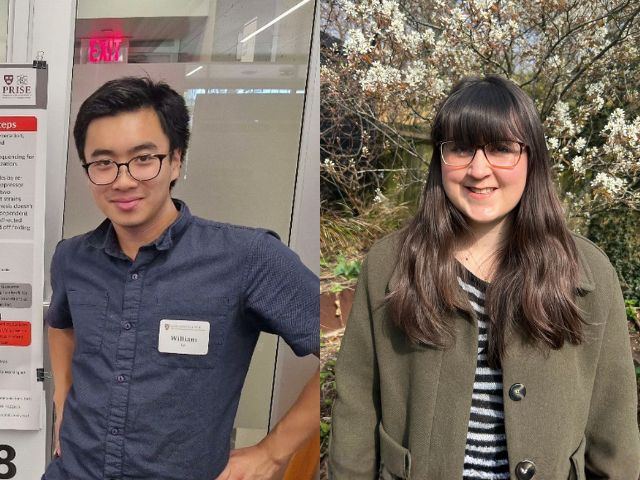
Two Churchill College students spent their summer conducting cutting-edge scientific research at Harvard University, returning home with sharper laboratory skills, new international friendships, and a clearer sense of where their careers are heading.
Holly Curtis and William Le, both studying Natural Sciences, travelled to Boston to join Harvard’s PRISE (Program for Research in Science and Engineering) fellowship. Over nearly eight weeks, they worked as researchers in leading molecular biology labs, developing skills and a mindset that formal study alone rarely provides.
Holly joined Professor Kevin Struhl’s lab, where she investigated how specific DNA sequence motifs affect the way genes in yeast cells are processed. Her work involved designing and building a series of yeast strains to test her hypotheses, requiring her to master molecular cloning, PCR, and yeast culture techniques along the way. When experiments failed, as they inevitably do in research, she had to adapt protocols and find her own solutions.
“Working independently while also receiving mentorship by my supervisor taught me how to think critically about experiments in a way I had not done in the past, as I had to adapt lab techniques and protocols to fix failed experiments.”
Holly’s project was not fully completed by the end of the programme, but that has not been the end of the story. She remains in contact with the lab, which is continuing the experiments, and she is currently waiting to receive data so she can contribute to the final analysis.
William joined the Denic lab, where he took on a suppressor mutant screen project aimed at bypassing an essential gene in yeast. His days were filled with growing yeast cultures, running PCRs, cloning, and Western blotting. Working through the inevitable setbacks helped him develop what he describes as “the mindset of dogged resilience that one needs in order to do research,” and he sees the experience as invaluable preparation for the research projects that lie ahead in his degree and beyond.
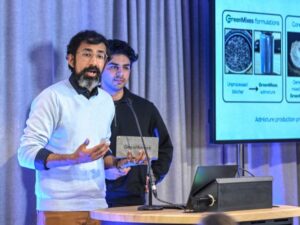
Both students had the opportunity to present their work at a poster session at the end of the programme, an experience they each found valuable for practising science communication and networking with academics, postdoctoral researchers, and fellow undergraduates from across the world. Holly also contributed an abstract to a student research book.
The academic experience was enriched by a wider programme of lectures from Harvard professors spanning economics, law, astrochemistry, and artificial intelligence. For Holly, these sessions were a chance to think about how scientific research connects to broader social and technological questions. For William, the whole experience opened up a more personal perspective: having grown up in Cambridge, spending the summer immersed in a different country and culture made him feel more confident about the idea of living and working abroad in the future.
The students also had the chance to explore Boston and the surrounding region, from watching the Red Sox at Fenway Park to visiting coastal towns north of the city.
Perhaps the most significant outcome of the internship for both students has been the clarity it has brought to their futures. Holly plans to complete Part III Biochemistry before applying for a PhD, and she credits the summer with confirming that research is the right path for her. William, likewise, had already been considering a PhD in biochemistry, but the experience gave him greater confidence in that decision. Having lived through months of experimental setbacks without losing enthusiasm, he feels better prepared for the realities of a research career.
This kind of formative opportunity, gained before either student has even completed their undergraduate degree, reflects what the partnership between Churchill and the Winston Churchill Foundation of the United States makes possible. The Foundation generously covers the costs of the programme, with the College providing additional support as needed. For students considering where to study, it is a reminder that the support a college offers can shape not just three or four years of university life, but the direction of an entire career.