
Medicine
Churchill has a quota of 10 Medicine students a year, including a maximum of one from outside the UK. We are in the unusually fortunate position that almost all our supervisors, for all six years of the course, combine clinical practice with research.
Unsurprisingly, the quality of supervision and care provided for medical students at Churchill is second to none and our students can see the clinical relevance of the cutting-edge scientific knowledge they acquire from the beginning of the course. The College’s blend of teaching expertise also provides students with role models and the motivation to embark on combined research and clinical careers, putting them in an ideal position to become leaders in the medical and veterinary professions. By fostering a collaborative and mutually supportive ethos, we are able to focus on every student’s development as an individual as well as creating a strong sense of community.
Entry Requirements
Churchill College’s standard A Level offer in Medicine is an A* in Chemistry, and A*A among Biology, Mathematics, Physics and Further Mathematics.
For IB, our standard offer is 43 points overall with 777 at Higher Level in Chemistry and two of Biology, Mathematics, Physics and Further Mathematics.
If you are taking other qualifications, please see the following University webpage for equivalent entry requirements: Check which qualifications we accept | Undergraduate Study
Other Requirements for Medicine
You cannot apply to this course if you have failed or been excluded from another medical school.
You must be 18 years old by November 1st during the year you matriculate – i.e., when you join the University and begin full-time study. This is due to national restriction and cannot be negotiated
For more information on this course, including additional expectations and information you will be required to provide, see the University course page: Medicine, MB and BChir | Undergraduate Study
Admissions Assessment
All Medicine applicants are required to take the University Clinical Aptitude Test (UCAT).
You must register for this in advance.
You can find more information about this assessment on the University webpage: University Clinical Aptitude Test (UCAT) | Undergraduate Study
Written Work
Written work is not required for Medicine.
Resources and support
If you’re looking to extend your knowledge of maths, you might enjoy exploring these websites:
Director of Studies
Professor Liz Soilleux
Dr Jason Ali

Professor Krishna Chatterjee
Studying Medicine at Churchill College
Success in Medicine requires application and hard work, both while you are learning and when you enter practice. However, it brings great rewards in terms of job satisfaction and the variety of career opportunities within the profession. Learning about and practising Medicine is also very enjoyable, involving as it does a combination of applied science and human interactions. The environment in which different types of Medicine are practised is rich and varied, and obviously continually changing. Doctors continue to learn throughout their working lives.
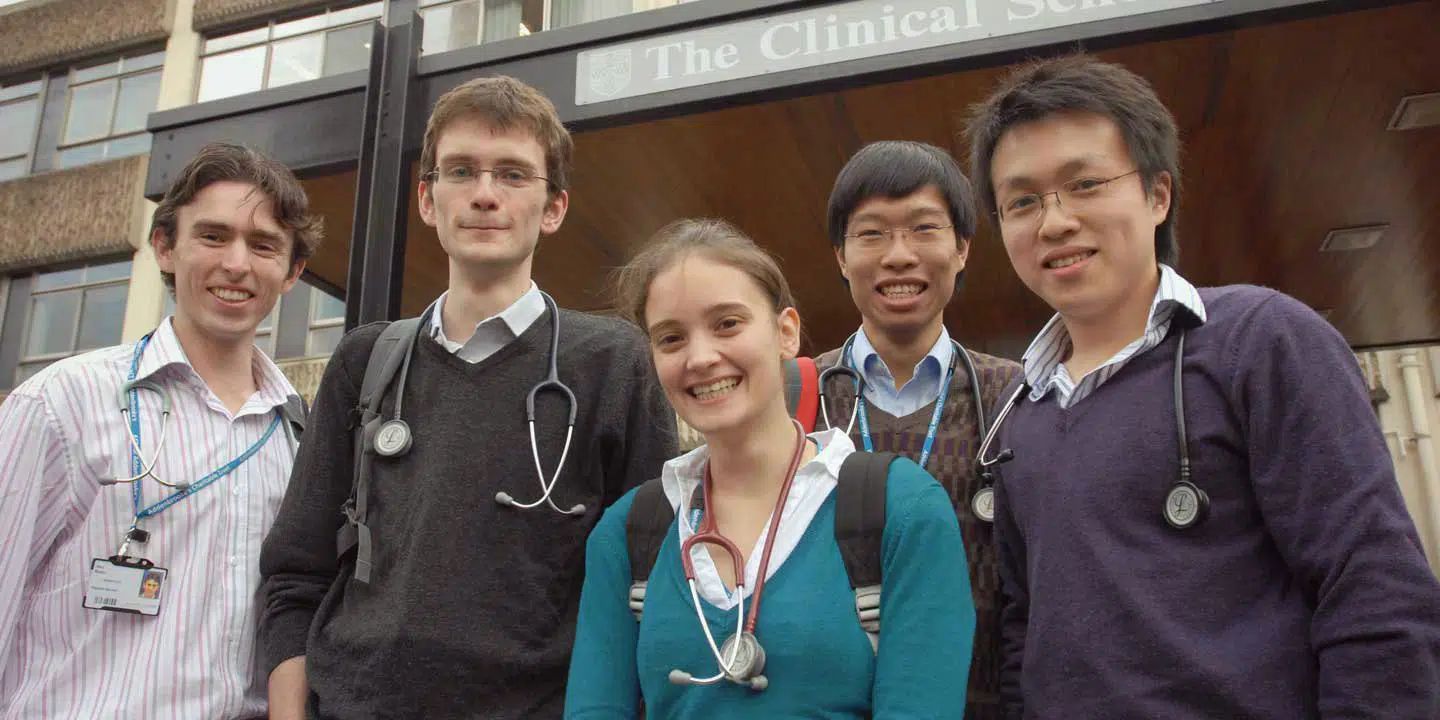
Reading Medicine at Cambridge comprises two phases: a three year pre-clinical phase, after which you would continue your clinical studies at the Cambridge Clinical School, based at Addenbrooke’s Hospital. The first three years of the degree include lectures, practical classes and examinations in a wide range of subjects including anatomy, biochemistry, genetics, neurobiology, pathology, pharmacology, physiology, psychology and reproductive biology. The clinical course builds on this foundation by developing the knowledge, skills, and attitudes you require to practise clinical Medicine: following an Introduction to Clinical Methods, the curriculum consists of three stages and is built around a number of major themes.
Full course details are provided on the School’s Prospective Undergraduates webpage and the University’s Undergraduate Study webpage.
Videos created by our Director of Studies:
Studying Medicine at Churchill College, University of Cambridge:
Applying for Medicine, Churchill College, University of Cambridge:
Why I love my subject
Masterclass: How to design a new cancer treatment:
From the Autopsy to Cutting Edge Diagnostics: a whirlwind tour of pathology.
You may also be interested in: