
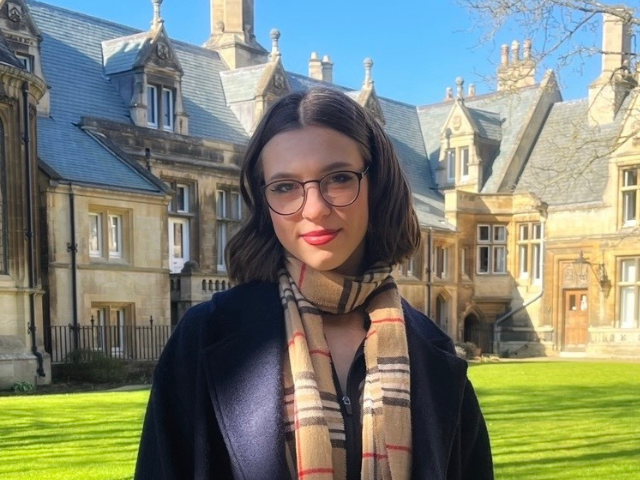
When second-year Natural Sciences student Sonya Badianova experienced an unexpected change in her summer internship plans, what could have been a frustrating setback turned into an opportunity that would prove transformative for her scientific development.
Thanks to support from Churchill’s Senior Tutor Dr Rita Monson, Sonya secured a place in the laboratory of Prof. Marko Hyvönen in Cambridge’s Department of Biochemistry. Funded by a Churchill College Summer Bursary, she spent the summer investigating domain interactions within the CK2 kinase enzyme, a protein implicated in a range of cellular processes, as well as exploring how it interacts with external proteins including the H1-like protein B4, in collaboration with the laboratory of Churchill Fellow Dr Katherine Stott.
Sonya’s work centred on engineering tagged protein constructs and designing pull-down assays to experimentally validate predicted protein interactions, the kind of precise work that lies at the heart of modern biochemical research. Under the guidance of her supervisor Léni Jodaitis, Sonya developed a broad suite of laboratory skills including protein expression and purification, SDS-PAGE, IVA cloning, NMR and Mass Spectrometry. She also conducted computational structural analyses using tools such as ChimeraX and AlphaFold.
By the end of her internship, Sonya had grown in confidence to the point of delivering a presentation to the entire research group, laying out the foundations of the project, sharing her experimental data, and inviting colleagues’ feedback. It was a significant moment for a student only in her second year of undergraduate study.
“This internship not only enhanced my practical and computational skills but also solidified my interest in pursuing biochemistry further in my degree. It was an honour to contribute meaningfully to ongoing scientific discussions within the lab.”
The bursary was, by Sonya’s own account, the factor that made full commitment possible, as she explains:
“Funding for Summer Opportunities is vital for Churchill students as it enables them to pursue projects that genuinely interest them, rather than selecting opportunities based primarily on financial considerations. Many departmental positions offered by lecturers and professors currently depend on external funding, so the Churchill bursary plays an important role in removing the burden of securing such funding for students.”
Away from the laboratory, Sonya competes for the University’s second team in Ballroom and Latin dancing in the novice category, and volunteers as a mentor for students from the STEM Smart programme. She describes Churchill as an incredibly spacious and welcoming College, where the variety of study and social spaces creates an atmosphere conducive to learning, with communal dinners in the dining hall a particular highlight for the sense of community they foster.
Looking ahead, Sonya hopes to pursue a career in pharmaceutical chemistry with a focus on drug design and analytical methods, ambitions that her summer in the lab helped to confirm. Her experience is a testament to the difference a well-timed intervention can make, with College support turning a difficult situation into one of the most valuable experiences of her time at Cambridge thus far.